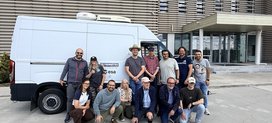
RS-Lab members at Lidar Intercomparison Campaign in Magurele, Romania 2026
During 16-28 Spetember 2026 members of the Remote Sensing Laboratory (RS-Lab) lead by prof. Iwona Stachlewska took part in the Lidar Intercomparison Campaign conducted research at the Magurele Centre for Atmosphere and Radiation Studies (MARS) of the National Institute of Research and Development for Optoelectronics (INOE). The MARS facility is part of the distributed pan-European Aerosols, Clouds and Trace Gases Research Infrastructure (ACTRIS) and plays an pivotal role in atmospheric remote sensing and lidar calibration activities serving as the ACTRIS Centre for Aerosol Remote Sensing (CARS).
The main objective of the campaign was to acquire and compare the signals collected with APD and PMT at 1064 nm (IR) of several lidars operated by researches and technicians from the MARS-INOE (Romania) - ALPHA and RALi lidars, Ludwig Maximilian University of Munich (Germany) - POLIS lidar, University of Warsaw (Poland) - EMORAL lidar, Consiglio Nazionale delle Ricerche (Italy) - M3DUSA lidar, and the Leibniz Institute for Tropospheric Research (Germany) - PollyXT lidar. Raymetrics S.A. (Greece) and Licel GmbH (Germany) participated in the campaign providing vital technical support.
Prof. Iwona Stachlewska, dr Łucja Janicka, PhD student Maciej karasewicz, MSc students Katarzyna Gabzdyl and Magdalena Konieczny, and BSc student Ada Jankowska took active part in the campaign oniste and PhD student Afwan Hafiz provided online support throughout the campaign. The lidar measurements were conducted using the ESA Mobile Mie-Raman Lidar (EMORAL), developed within the ESA-funded POLIMOS project led by prof. Iwona Stachlewska. A series of quality assurance tests, including telecover, polarization calibration, and Rayleigh-fit tests were performed. The optical triggering of data acquisition system versus conventional laser was done. Core challenge was assessment of signal distortions in dark measurements and testing of modern types of the APD detectors developed by Licel GmbH.
During campaign students gained practical experience in data analysis using ATLAS software and unique opportunity to work with researchers from all participating institutions to identify and address technical issues affecting the EMORAL instrument. In addition, researchers from INOE provided professional training for students, including an in-depth introduction to lidar systems and their operation.
The research visit was supported by a grant awarded to Magdalena Konieczny within the COST Action CA24135, European Atmospheric Research Lidar COoperation on Science and Technology (EARLICOST), entitled “Assessment of 1064 nm Detection Solutions for ESA Mobile Mie-Raman Lidar (ADS-EMORAL)”.
We thank Opto-Electronics section (TEC-MME) at the European Space Research and Technology (ESTEC) of the European Space Agency (ESA) for providing the ESA Mobile Raman Lidar EMORAL that was developed in a non-commercial scientific collaboration of the University of Warsaw (UW), the Ludwig Maximilian University of Munich (LMU), and Raymetrics S.A. within “Technical assistance for Polish Radar and Lidar Mobile Observation System (POLIMOS)” funded by ESA-ESTEC Contract no. 4000119961/16/NL/FF/mg.
The Warsaw ACTRIS National Facility of the University of Warsaw receives support from the Ministry of Science and Higher Education of Poland through the ACTRIS-ERIC grant (2024/WK/04).
Originally published on - Oct. 13, 2026, 9:34 a.m.
Last update on - Oct. 13, 2026, 9:51 a.m.
Publisher - Sekretariat IGF